

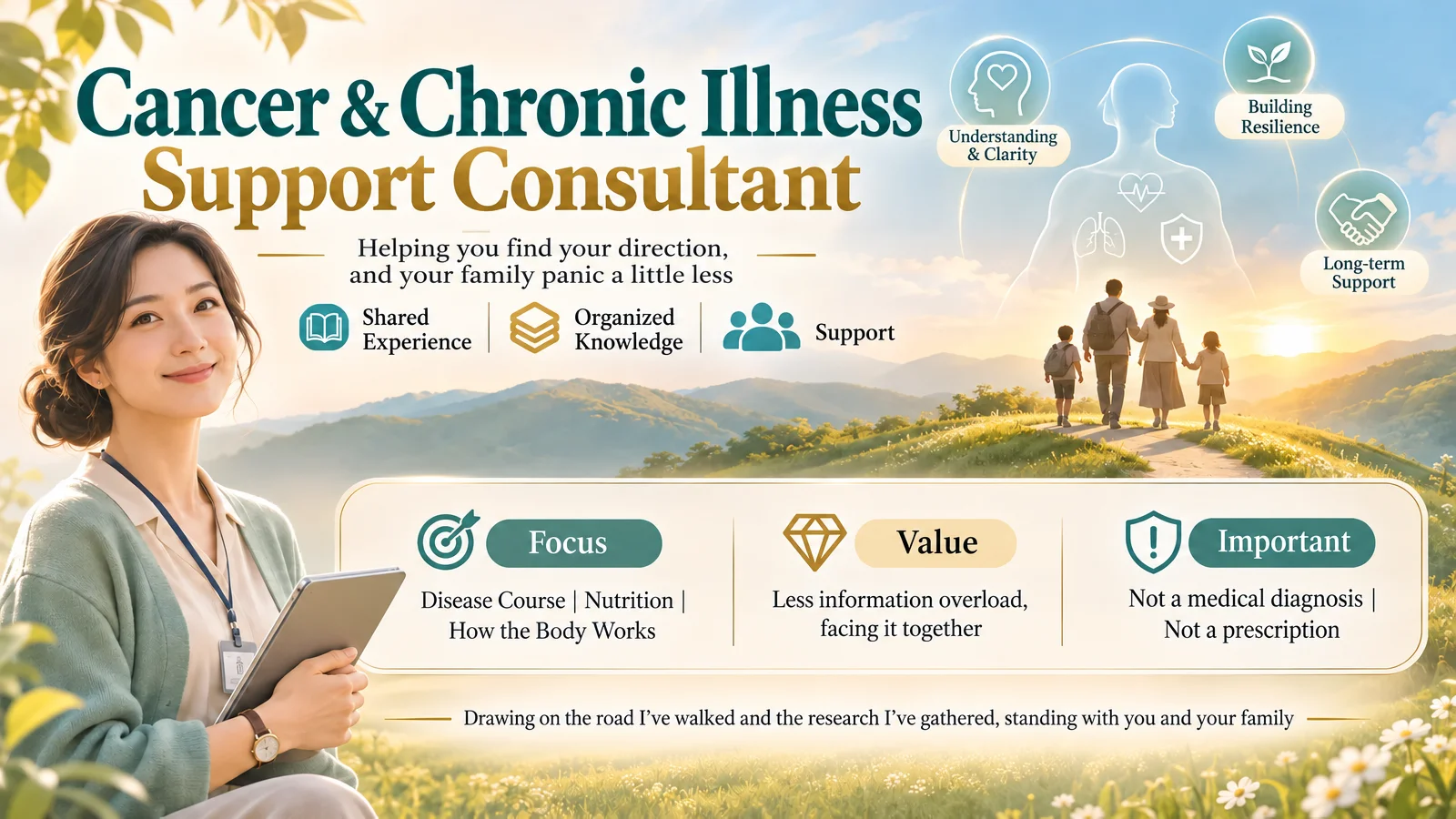
Cancer & Chronic Illness Support Consultant
As family members and friends went through illness, I experienced firsthand the fear, helplessness, and uncertainty of standing by them as they faced disease. It was especially painful when their illnesses reached a late stage. I could only watch the people I deeply loved suffer: some had even had organs removed, and chemotherapy had broken their bodies down to the point that they were bedridden, yet I had no idea what else I could do. That feeling of total helplessness is still deeply etched in my heart.
That’s why I started spending time researching disease mechanisms, physiology, nutrition, and how the human body works. I hope to share what I’ve observed over the years, and the road I’ve walked myself, with people who are going through the same thing.
Over the years, I’ve also sought out and met with many people with cancer, paying special attention to stories of improvement that people call “miracles.” I’ve always wondered: are these miracles just luck, or are there patterns behind them worth studying? Do different cases share something in common that nobody has noticed?
I know this isn’t an easy road. Long-held beliefs and habits often make it hard to step outside the existing framework, and on top of that, information about disease is overwhelming and the information gap is huge. For patients and families facing illness, just trying to make sense of the problem in front of them and understand the different points of view is already a tough test.
I don’t expect everyone to agree with my ideas. I just hope that what I’ve researched, observed, and organized over the years can give the people who need it one more way of looking at the problem.
Based on what I’ve learned and observed, I pay particular attention to the body’s natural repair mechanisms and to how bodily functions and the capacity for repair may change before and after surgery, chemotherapy, and radiation therapy. I keep wondering whether, when the body is damaged again and again, something like this is happening:
For a while, repair simply can’t keep up with the damage.
I’m always hoping patients get better, and if we ever get the chance to meet, I’d love to sit down for a meal with you and your family! 😆
Who knows, one day I might somehow end up with a whole bunch of godparents, god-brothers, and god-sisters, and more holiday family dinners than I could ever finish 🤣
⚠️💀 Important Notice and Health Risk Reminder
The content on this page is personal experience and general knowledge only. It is not a medical diagnosis, a treatment prescription, or individualized medical advice. Please weigh any health-related decision carefully yourself and consult a qualified healthcare professional.
💀 The cytotoxic drugs used in chemotherapy can cause serious side effects, and some effects may even last long-term. Actual risk depends on the type of drug, the dose, and the person’s physical condition.
💀 The high-energy radiation used in radiation therapy destroys cancer cells, but it can also harm normal tissue within the treated area, causing skin damage, tissue fibrosis, lymphedema, and even long-term damage to the lungs, heart, and other organs. Some aftereffects may only show up years after treatment ends, and radiation exposure may also raise the risk of developing a second cancer later on. Actual effects depend on the treated area, total dose, treatment technique, and individual health factors.
💀 Removing an organ can have irreversible, even lifelong, effects on the body. Every organ in the body has its own specific physiological functions. Once it’s removed, digestion, absorption, metabolism, immunity, or other regulatory mechanisms may be affected, and some functions may never fully recover. Surgery can also bring bleeding, infection, and other complications, and a severe infection can even lead to life-threatening sepsis. Actual effects depend on which organ is removed, the extent of the surgery, and the person’s physical condition.